
The budget
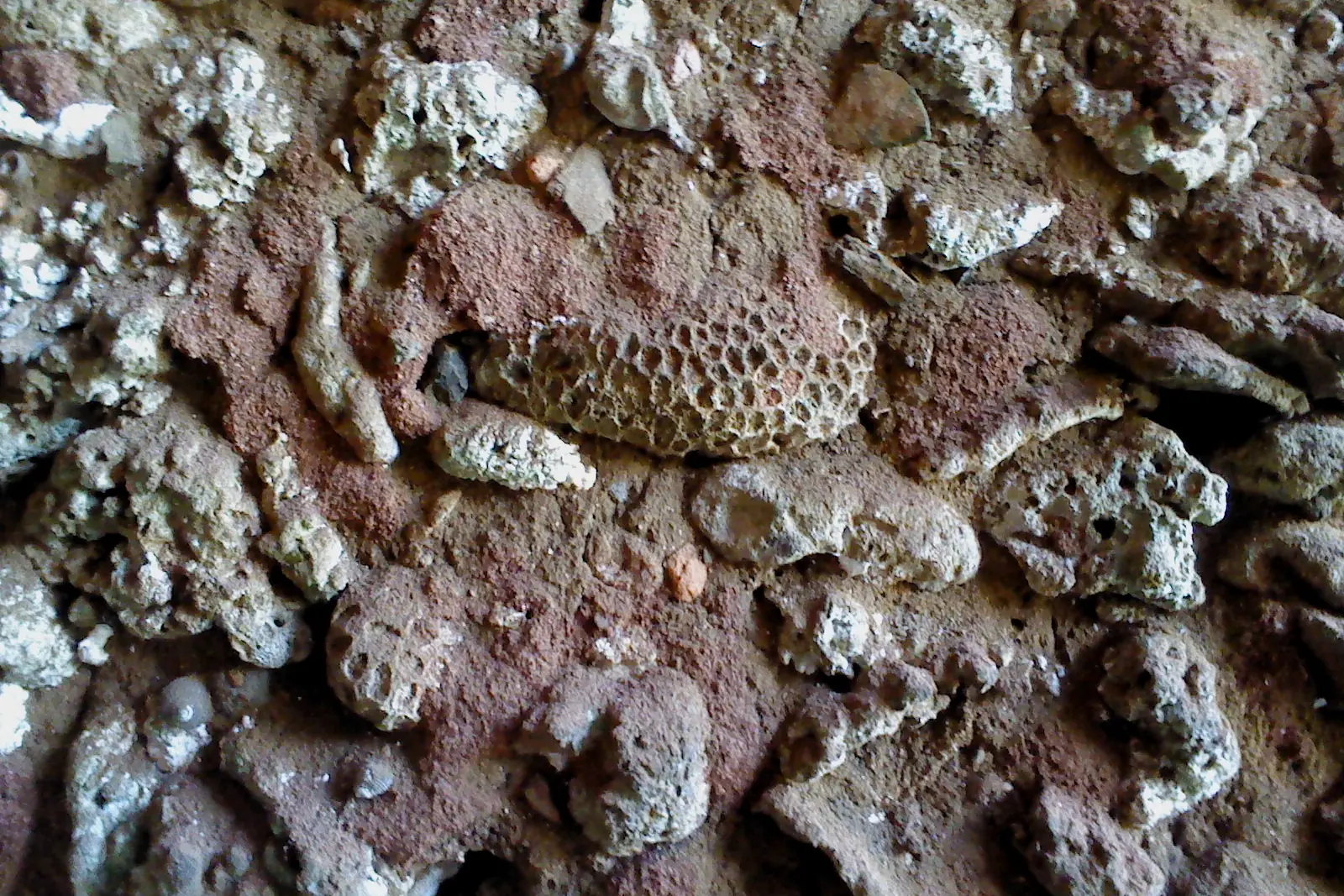
Every material decision in Penghu answers to one accounting. Basalt and coral limestone were free but heavy, awkward and slow. Lime was cheap but needed fuel, on an island with no firewood. Timber and roof tile were good but had to be shipped from Xiamen, at a cost the gazetteers record without comment because it was simply a fact of life.
The consequence is a building culture in which stone does everything it can, lime does everything stone cannot, and timber does only what nothing else will.
- Basalt
- Dense, dark, hardPlinths, lintels, thresholds, paving, field walls, weirs.
- Coral limestone
- Light, porous, grippyWall bodies above the plinth, boundary and crop walls.
- Shell lime
- Burnt on siteBedding mortar and the render that seals a porous wall.
- Timber and tile
- Shipped from XiamenRoof framing, doors, gates. Used as little as possible.
Two stones, two jobs
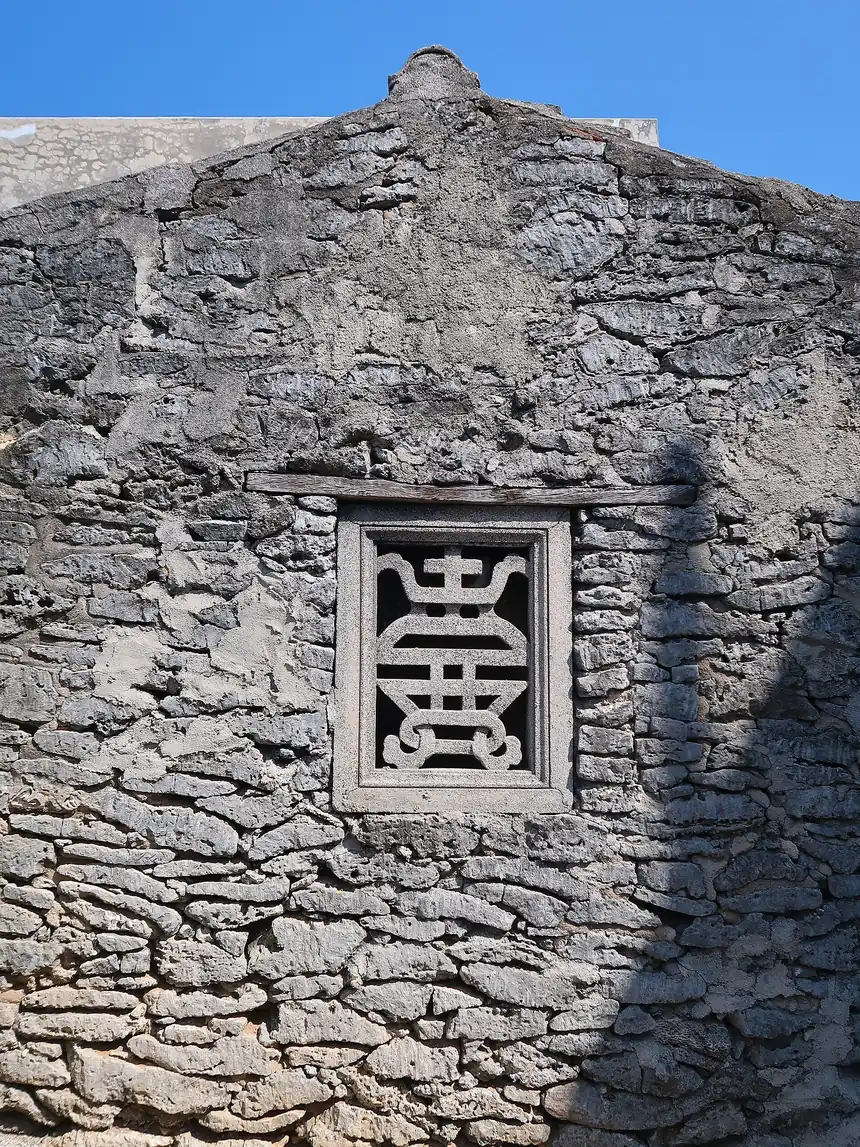
The division is consistent enough to be diagnostic. Basalt goes where the wall meets the ground, the weather and the sea: base courses, corners, lintels, steps, paving, and anything exposed to standing salt water. Coral limestone goes above, where the wall only has to hold itself up and where a light block that keys into its neighbour is worth more than a hard one that does not.
Read any unrendered Penghu wall from the bottom up and the switch is visible as a change of colour and grain, usually within half a metre of the ground. How the two are graded, coursed and bedded is set out in stone masonry.
What was not available
No structural timber, no fired brick of quality until the twentieth century, no stone that could be worked finely, no cement. There is also no local clay worth firing: the gazetteers note that locally made tile was inferior and that the good stuff came by boat.
The absence that mattered most was trees, and it was self-reinforcing. Salt-laden wind kills most woody growth on an exposed island, so there was no timber, so buildings used short spans and load-bearing masonry, so nobody planted for construction.
And then it stopped
The material system did not evolve into something else. It was replaced, quickly, between roughly 1957 and the early 1970s, by hollow concrete block and brick manufactured on the islands. See the substitution for how that happened and what it means for what survives.
Sources
- “硓𥑮石” [Coral stone], penghu.info knowledge platform, citing the Penghu Prefecture Gazetteer, Penghu County Records and the Xiyu Township Record.
- “澎湖傳統民宅” [Penghu vernacular dwellings], penghu.info knowledge platform, compiling the Penghu Prefecture Gazetteer and township records.
- “Black Pearls in the Ocean: The Basalt of Penghu”, Taiwan Panorama, July 2002.
- Chang Yu-tong (張宇彤), “澎湖傳統民宅形式衍化及意涵” [The evolution and meaning of Penghu vernacular house form], in Penghu Research: Proceedings of the 10th Academic Symposium, National Penghu Living Museum. Text archived at penghu.info.