
Where it came from
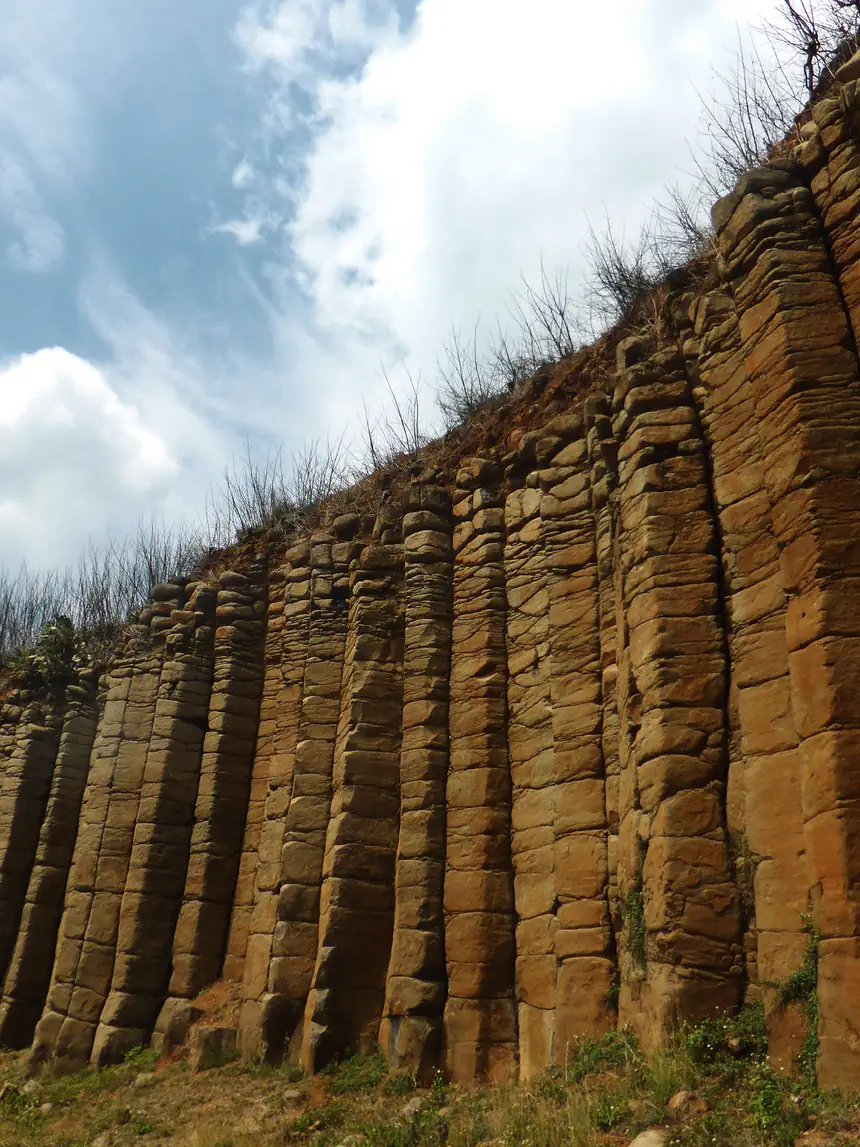
The archipelago is the eroded remnant of a Miocene shield-volcanic province in the Taiwan Strait. Lava reached the surface through fractures in the crust rather than in explosive eruptions — basaltic lava is low in silica and runs easily — and it built up in sheets, interbedded with shallow-marine sandstone and mudstone. Two to four basalt layers are typically exposed in section.
Activity began about eighteen million years ago. The oldest basalt in the archipelago, at Wang’an, is around seventeen million years old; the last eruption, at Dongyuping, was about eight million years ago. The rock inside the columnar basalt nature reserve dates from 13.2 to 11.8 million years ago.
What it does in a wall
Basalt is dense, fine-grained, non-absorbent and extremely durable. Those properties matter in exactly one situation, and Penghu has that situation everywhere: a wall standing in salt spray with water rising through it from below.
- Plinths and base courses
- Two or three courses of basalt at the foot of a wall stop capillary rise and take the abrasion of splash. Above that, coral limestone can be used safely.
- Lintels, thresholds, jambs
- The few places where a piece of stone has to span or take concentrated wear. Dressing basalt is laborious, so these are the pieces that got the labour.
- Paving and forecourts
- Irregular slabs laid tight, still the characteristic ground surface of an old Penghu lane.
- Field and boundary walls
- Dry-laid, often in combination with coral. Penghu’s walled crop plots use whichever of the two was nearer.
- Stone weirs
- The intertidal weirs are built from basalt and reef limestone together. Basalt gives the mass that holds a wall against a running tide.
Why the columns matter to a builder
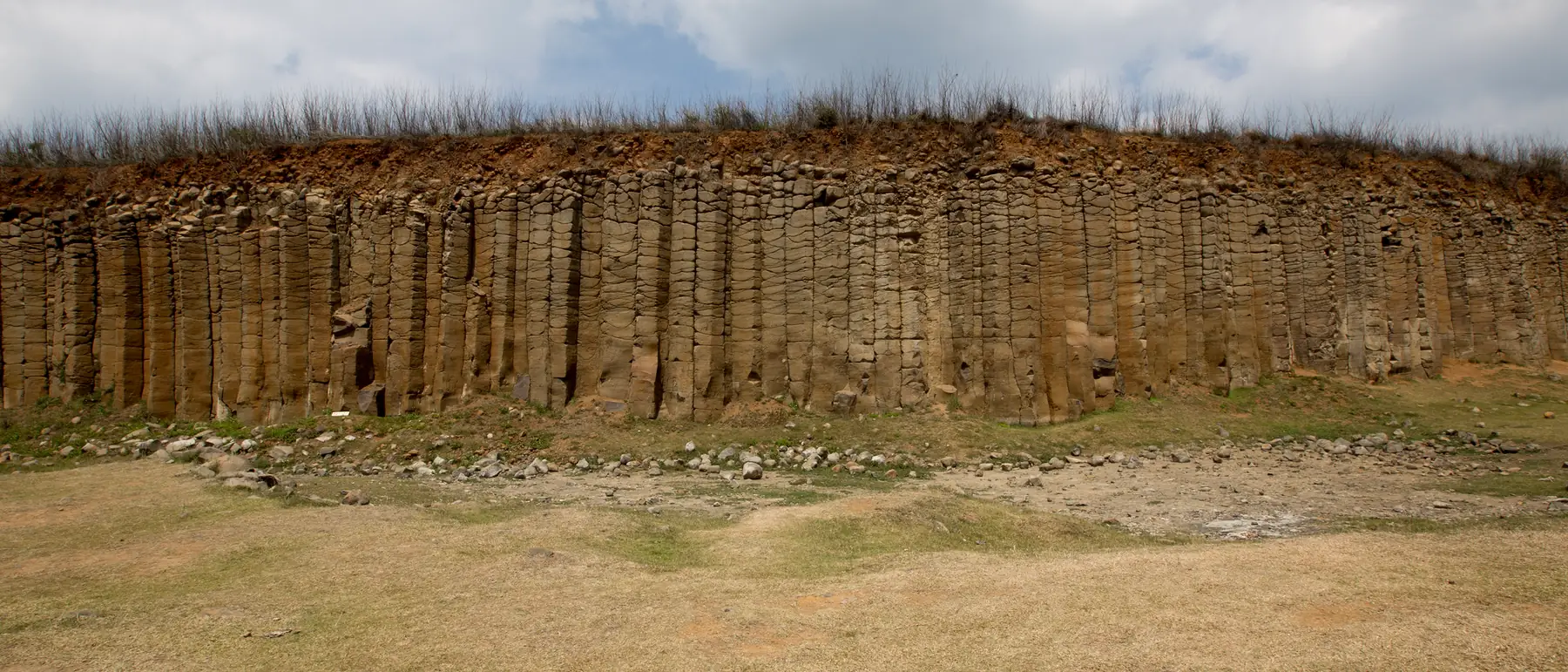
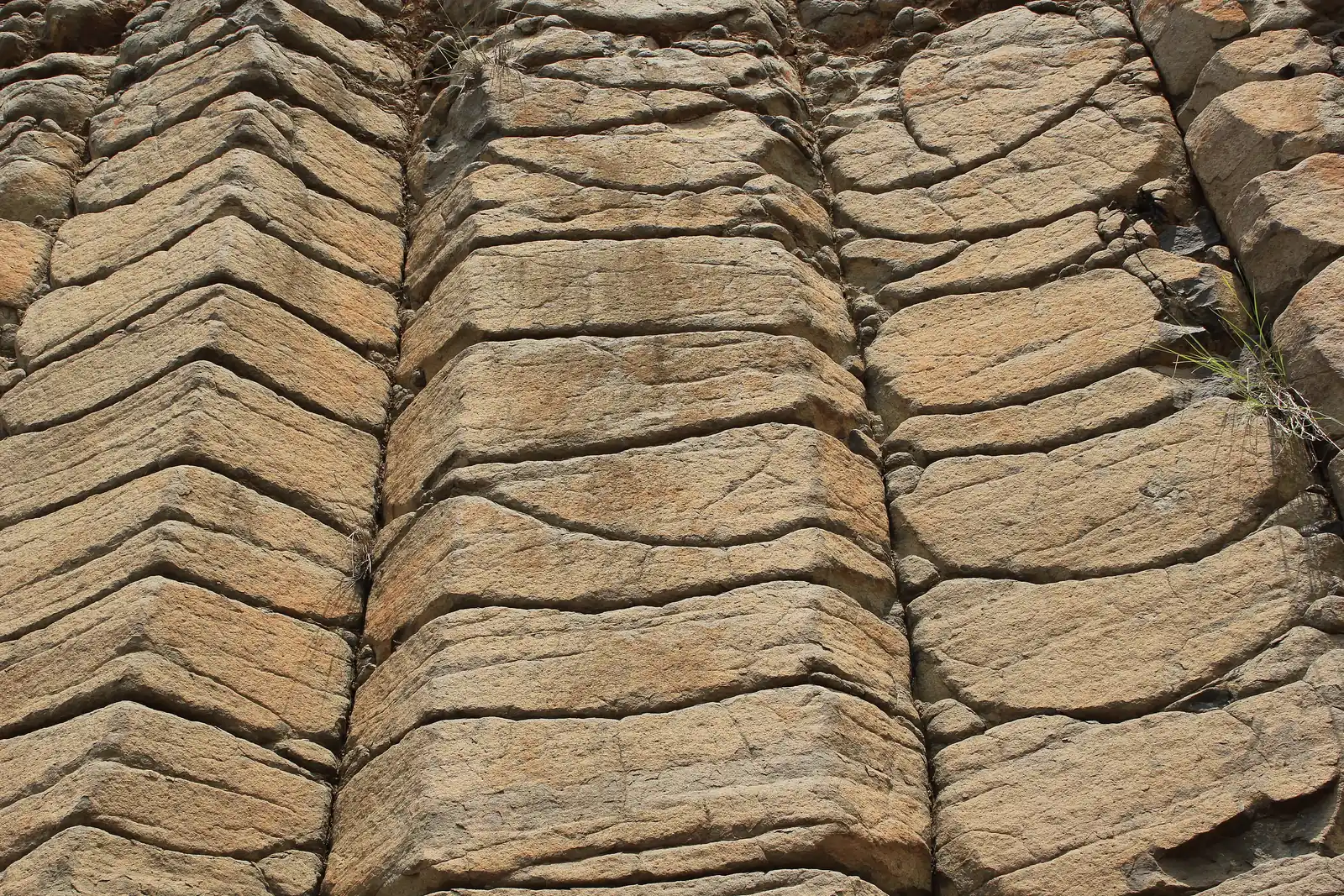
As lava cools it contracts, and the contraction cracks propagate as a polygonal network — commonly five- and six-sided — downward through the flow. The result is a rock mass that is already divided into long prismatic blocks before anyone touches it.
That is a quarrying gift. A columnar outcrop yields stone in usable lengths with two or three flat faces already formed, without the expense of splitting a massive body. It is a large part of why basalt was worth handling at all in a place with no lifting equipment.
Where the stone is, and where it may not be taken
Basalt outcrops across the archipelago. The finest formations are protected. The Penghu Columnar Basalt Nature Reserve, declared in 1992 under the Cultural Heritage Preservation Act, covers three uninhabited islets in the northeast — Xiaobaisha, Jishan and Dinggou — amounting to 19.13 hectares at high tide and 30.87 hectares at low tide, with a buffer zone of 74.96 hectares. It is Taiwan’s only nature reserve constituted on basalt.
The reserve is also on Taiwan’s list of potential World Heritage sites, argued under the criteria for natural beauty, for earth history, and for habitat: it holds 52 bird species across ten orders, with protected terns breeding from April to September.
- Volcanic activity
- 18–8 MaFrom the first lava to the last eruption at Dongyuping.
- Reserve declared
- 1992Under the Cultural Heritage Preservation Act.
- Reserve area
- 19.13 haAt high tide; 30.87 ha at low tide, plus a 74.96 ha buffer.
Column height
The tallest exposures in the archipelago reach sixty to seventy metres, with fanned, radiating and toppled “domino” arrangements where the flow cooled unevenly. Those are maxima, not typical figures: most accessible outcrops are a few metres high, which is exactly what makes them workable.
Sources
- Penghu Columnar Basalt Nature Reserve, Potential World Heritage Sites in Taiwan, Bureau of Cultural Heritage, Ministry of Culture.
- “Black Pearls in the Ocean: The Basalt of Penghu”, Taiwan Panorama, July 2002.
- Penghu, Wikipedia, for administrative and climate-normal figures only.
- Daguoye Columnar Basalt, Tourism Administration, MOTC.