
Three pressures at once
Between the late 1950s and the early 1970s three things happened together, and the combination was fatal to the old way of building.
- Supply was restricted. A 1957 agreement between Shagang and Hongluo limited extraction near a stone weir; a 1962 regulation confined collection to loose stone and banned blasting and pick excavation; the county magistrate then barred coral stone from public construction altogether and offered extractors a three-year transition into other work.
- A substitute arrived. Hollow-block and brick works opened on the islands during the 1960s. Block needed no seasoning, no grading, no skilled bond and no salvage.
- The labour left. Penghu’s population peaked at just over 119,000 in 1970 and has fallen since. Building in stone is labour that a shrinking, ageing population could not supply.
Why block won on the merits, not only on price
It is tempting to read the change as pure loss. From a householder’s point of view it was not. Block and concrete allowed larger openings, taller rooms, real cross-ventilation, a second storey without a mason, and — decisively — a building that could be finished in months rather than assembled over a decade of stone-carrying.
What was given up was the performance that had justified the old system: the thermal mass, the breathability of a lime-rendered porous wall, the wind profile of a low aligned cluster. Penghu’s post-1960s housing is measurably less comfortable in this climate than what it replaced, and is also much easier to live in. Both are true.
The pattern it leaves on the ground
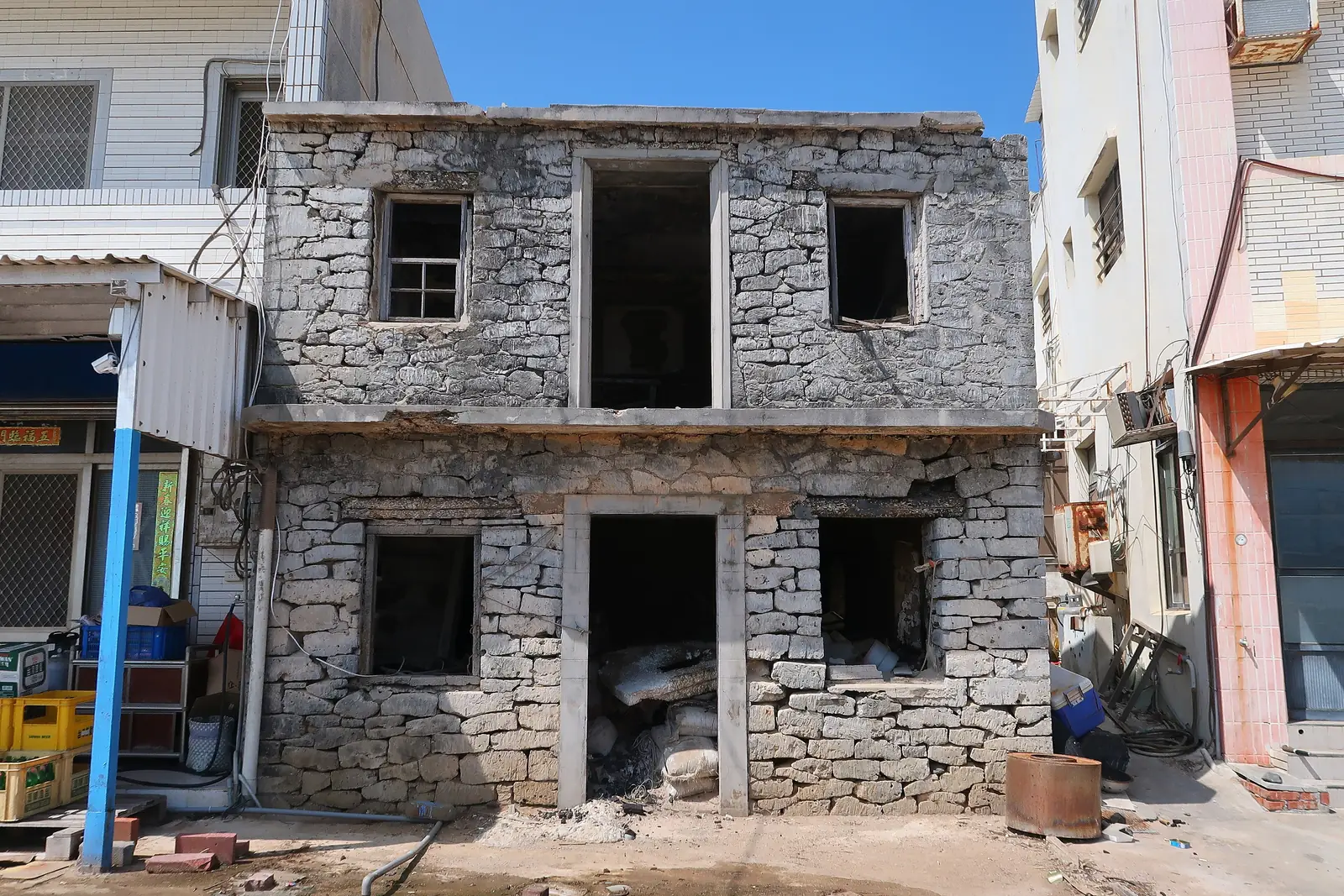
Almost every Penghu settlement now reads as two building cultures on one street. Concrete occupies the accessible edges and the road frontage; the stone fabric survives in the interior, where the lanes are too narrow for a truck and the plots too small to rebuild on. Villages have lost their centres rather than their outskirts.
The conservation problem
Three constraints bind at once.
- Material
- Coral stone cannot be extracted. Repair depends on salvage from collapsed buildings, a bank that only shrinks.
- Skill
- Nobody has built a coral wall as ordinary work since the 1970s. The technique survives in conservation projects, not in a trade.
- Fabric
- A Penghu settlement is aerodynamically continuous. Losing a house in the middle of a row exposes its neighbours to wind they were never detailed for, so decay propagates along a block rather than staying put.
This is why Penghu conservation has tended to work at settlement scale — the 2001 preservation area at Erkan, the national listing of Zhongshe in 2010 — rather than by protecting individual monuments. Protecting one building in a Penghu village does not protect the building.
Sources
- “硓𥑮石” [Coral stone], penghu.info knowledge platform, citing the Penghu Prefecture Gazetteer, Penghu County Records and the Xiyu Township Record.
- Penghu, Wikipedia, for administrative and climate-normal figures only.
- Chen, Chao-Yuan & Lee, Ming-Ju, “Evolution of stone fish weirs in Jibei area, Penghu Archipelago (eighteenth to twenty-first century)”, Journal of Maps 19(1), 14 November 2023. Open access.
- 望安花宅聚落 [Wang’an Huazhai Settlement], case 20100414000001, National Cultural Heritage Network, Bureau of Cultural Heritage.