
The rules of the bond
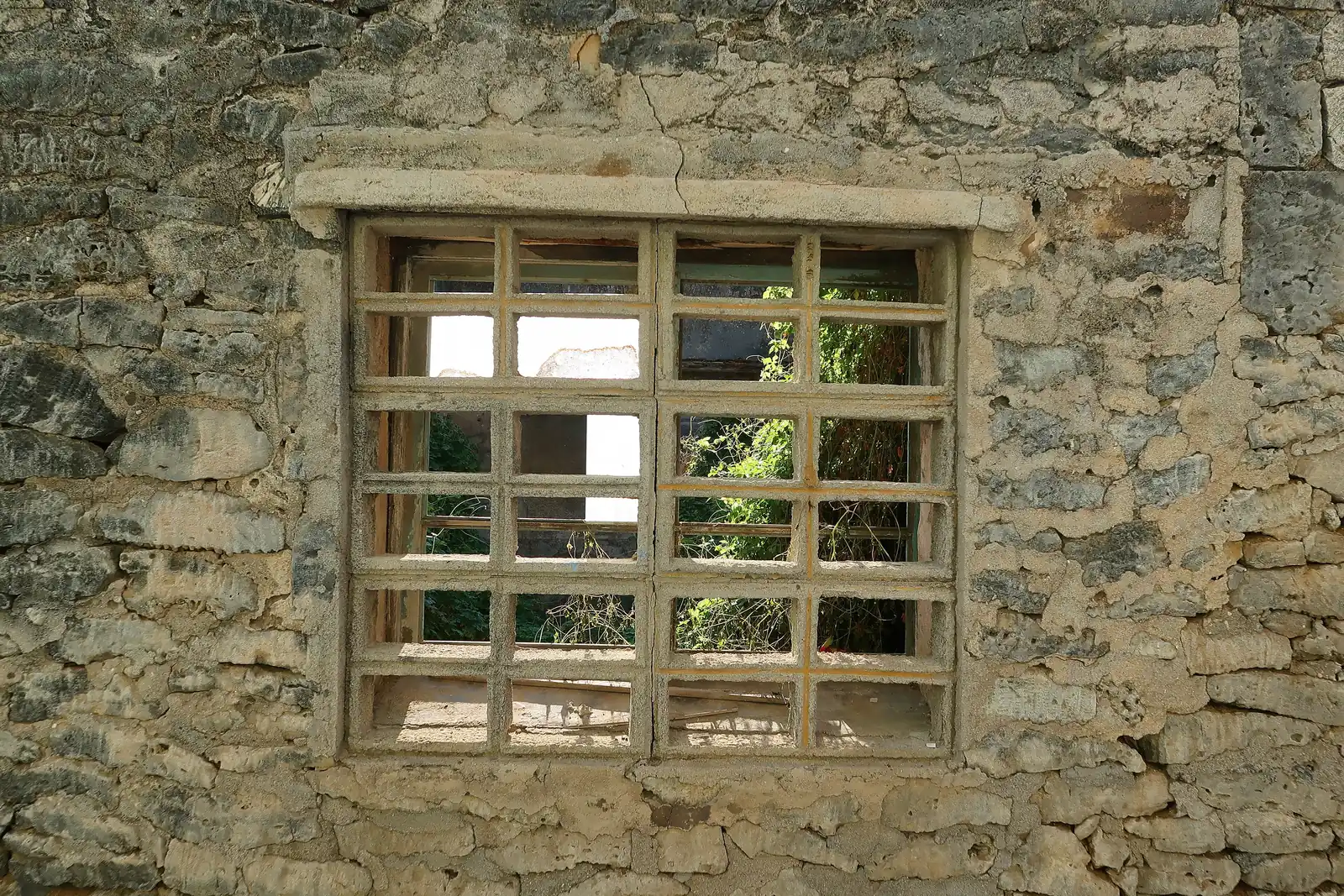
Penghu walling is rubble work with a strong internal logic. There is no dressed ashlar outside of lintels, jambs and thresholds, and there are no true courses in the sense a brick wall has them. What there is instead is grading.
- Largest stone lowest. The base takes the biggest, squarest, heaviest blocks — basalt where it can be got.
- Corners get the best pieces. A rubble wall is only as good as its quoins, and in Penghu these are the stones that were actually selected rather than merely placed.
- Size decreases upward. Not evenly, but consistently enough to see.
- Openings are framed. Around a door or window the mason reverts to larger, flatter stone so the reveal holds a line.
- Spalls fill the voids. Small chips driven into the gaps do most of the work of locking the face.
Lime
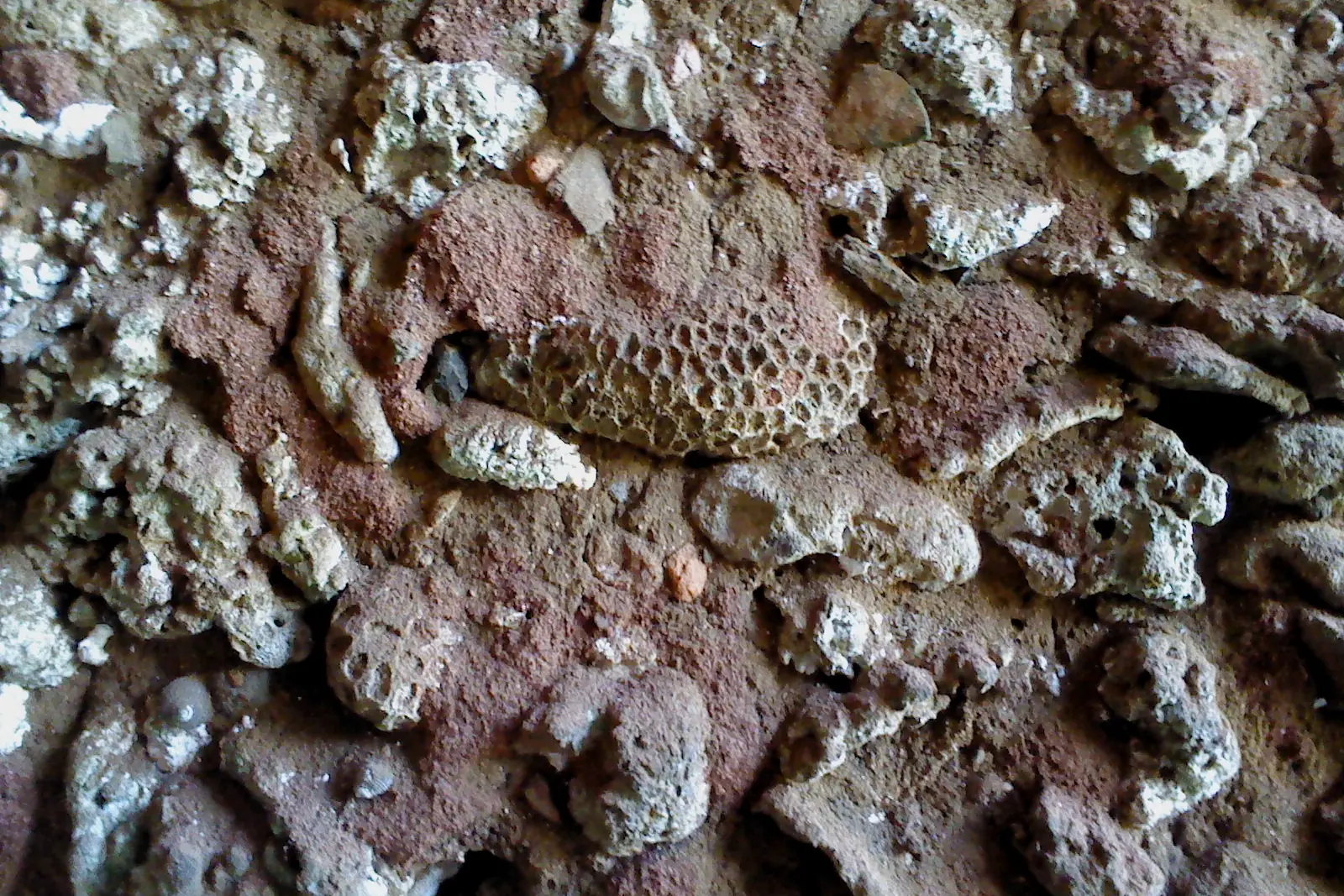
The binder is lime, burnt from shell and coral — the only calcium source on a treeless island, and one that also required scarce fuel. It does two different jobs.
As bedding mortar it is not an adhesive so much as a packing: it beds irregular stone onto irregular stone and distributes load across contact points that would otherwise be a few sharp edges. A coral wall is held up by friction and interlock, with the lime making the interlock reliable.
As render it is the wall’s weatherproofing. Coral limestone is porous and would otherwise carry salt-laden spray straight through the thickness of the wall to the inside face. A lime render, applied outside and often inside too, closes the surface while staying vapour-permeable, so the wall can still dry.
Reading a wall
- Where does the stone change?
- The height of the basalt-to-coral transition tells you how exposed the builder judged the base of that wall to be.
- How regular is the grading?
- A carefully graded wall with tight spalling is a house someone paid for. A wall of mixed sizes thrown together is a store, a sty or a boundary.
- Is the face rendered, and is the render original?
- Original lime render is thin, slightly uneven and the same colour as the mortar. Later cement is flat, grey and cracked in straight lines.
- How wide are the joints?
- Wide joints mean the stone was not graded to fit and the mortar is carrying more than it should. Those walls are the ones that disaggregate first.
Dry stone
Not every Penghu wall uses lime. Field walls, crop-plot enclosures and the intertidal weirs are laid dry, deliberately. A dry wall lets wind and water through instead of resisting them: a dry crop wall diffuses a gust rather than creating a damaging eddy behind it, and a dry weir wall drains as the tide falls instead of being pushed over by the head of water behind it.
Knowing when not to use mortar is as much a part of the technique as knowing how to mix it.
Sources
- “硓𥑮石” [Coral stone], penghu.info knowledge platform, citing the Penghu Prefecture Gazetteer, Penghu County Records and the Xiyu Township Record.
- Chang Yu-tong (張宇彤), “澎湖傳統民宅形式衍化及意涵” [The evolution and meaning of Penghu vernacular house form], in Penghu Research: Proceedings of the 10th Academic Symposium, National Penghu Living Museum. Text archived at penghu.info.
- Chen, Chao-Yuan & Lee, Ming-Ju, “Evolution of stone fish weirs in Jibei area, Penghu Archipelago (eighteenth to twenty-first century)”, Journal of Maps 19(1), 14 November 2023. Open access.