
What it is, and what it is not
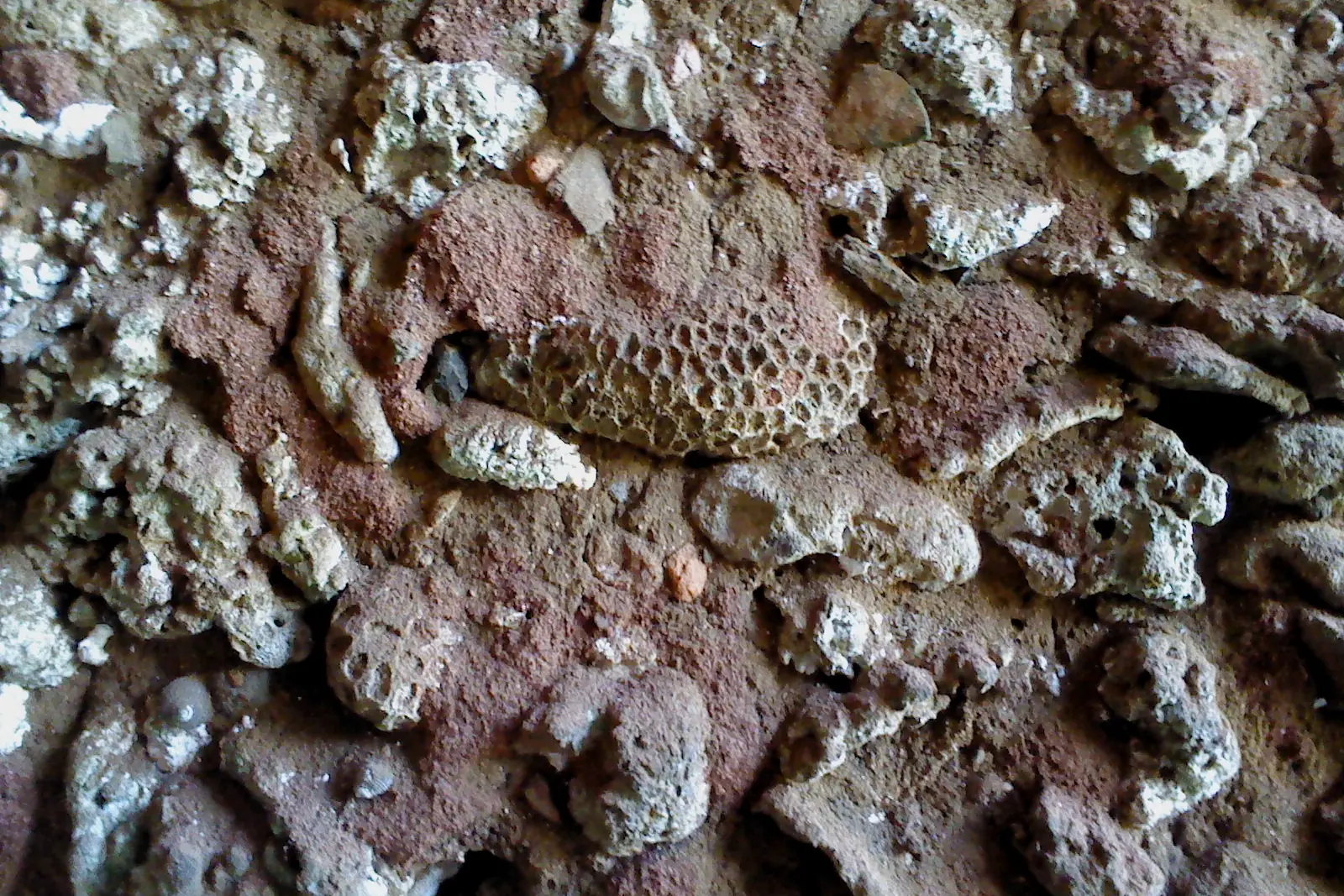
It is fossil coral-reef limestone: the skeletons of long-dead reef organisms, consolidated into rock. It is not living coral, and the houses were not built by breaking up a working reef. The material comes from old reef platforms that run out from the Penghu coast — in places more than ten kilometres seaward — with only a sparse veneer of living coral over them.
The name is unstable even in Chinese. It is written 硓𥑮石, 咾咕石, 咕咾石, 𥑮硓石, 老古石 and 螻蟈石; Qing sources such as the Dongying zhilüe and the Taiyang jianwen lu use several of these. This publication writes it 咾咕石 and romanises it laogushi, with the variants recorded in the glossary.
The three-year wait
A Qing-period record puts the process plainly: stone taken from the sea must be left until the salt taste is entirely gone, after which it becomes solid and fit for walling. Modern accounts give two to three years of weathering as the minimum and seven or eight years of exposure as ideal.
That waiting period is the hinge of the whole material economy. You could not decide to build a house and then obtain stone. You accumulated stone, for years, against a house you intended to build later — which is the literal sense of the Penghu saying 「欲娶某,先擔三年咾咕石」: to take a wife, first carry coral stone for three years.
Who supplied it
Extraction concentrated in the northern waters between the villages of Shagang and Hongluo. By the Taisho era eight households in Shagang worked at it as a speciality. After 1949 demand jumped with the military build-up: Hongluo had forty extracting households and Shagang nearly thirty, and the two villages fell into open competition.
The stone was measured and sold by the barrel of six cubic feet. Collection was by hand at low tide before it was mechanised.
| Date | Event |
|---|---|
| Taisho era 1912–26 | About eight Shagang households specialise in extraction. |
| 1949 | Demand surges with the ROC military build-up: forty extracting households in Hongluo, nearly thirty in Shagang. |
| July 1957 | Shagang–Hongluo dispute settled by agreement: no extraction within 250 m of Shagang’s stone weir, penalty up to 200 yuan. |
| 1962 | Regulation permits collection of loose “floating” stone only; blasting and pick excavation prohibited. |
| 1960s | County magistrate Li Yulin bans coral stone in public construction and offers extractors a three-year occupational transition. |
| 1960s–70s | Hollow-block and brick works on the islands supply a cheaper substitute; demand collapses. |
Why it worked so well
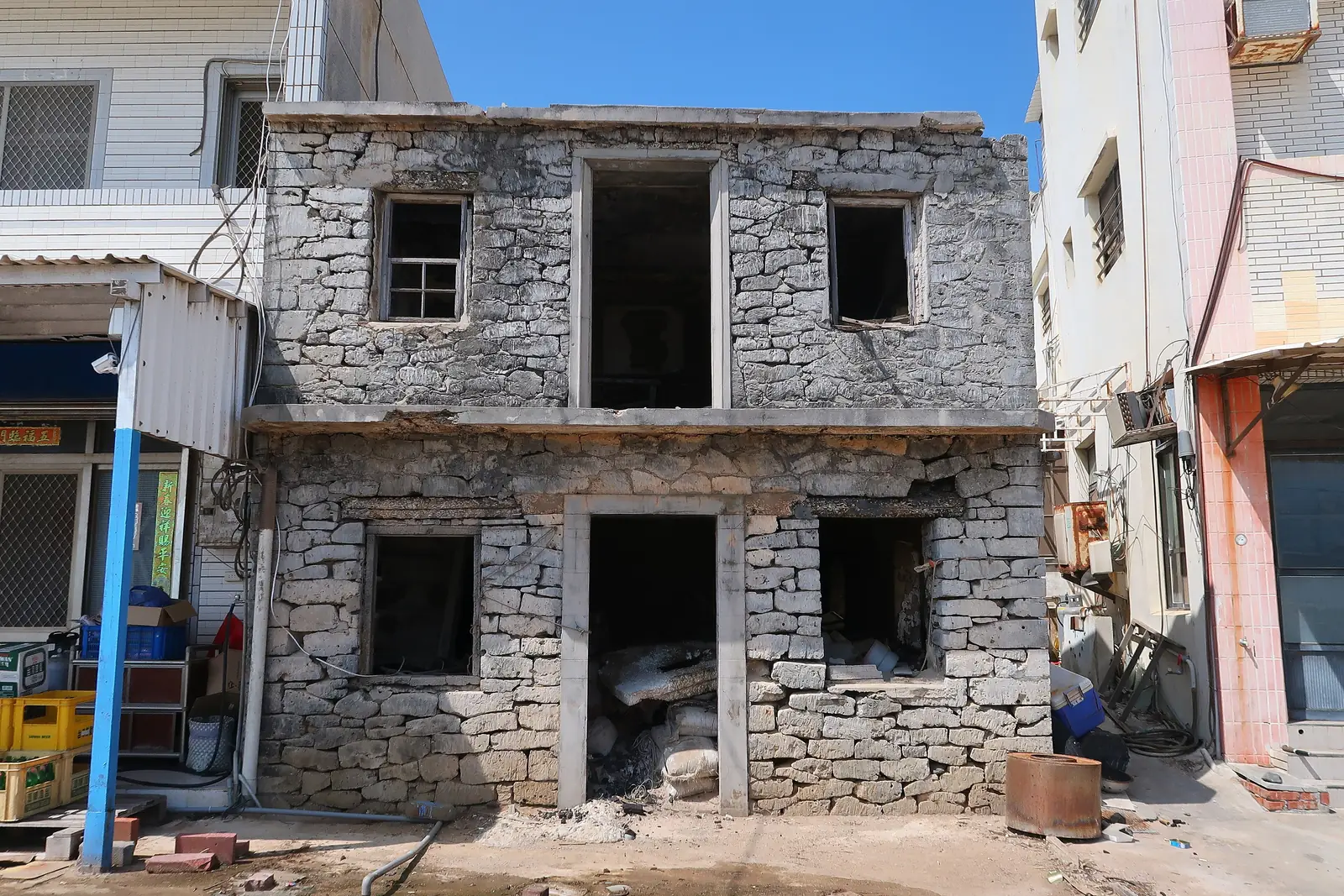
Weathered coral limestone has a surface no quarried stone can match: deeply pitted, all projecting edges and re-entrant hollows. Two blocks pressed together key into one another mechanically before any mortar is involved. Bedded in lime, a coral wall was described by contemporaries as performing comparably to reinforced concrete and as capable of carrying more than a single storey — a claim Jibei’s surviving two-storey shells support.
It is also light for its bulk and needs no dressing, which on an island without lifting gear is decisive.
Where it went
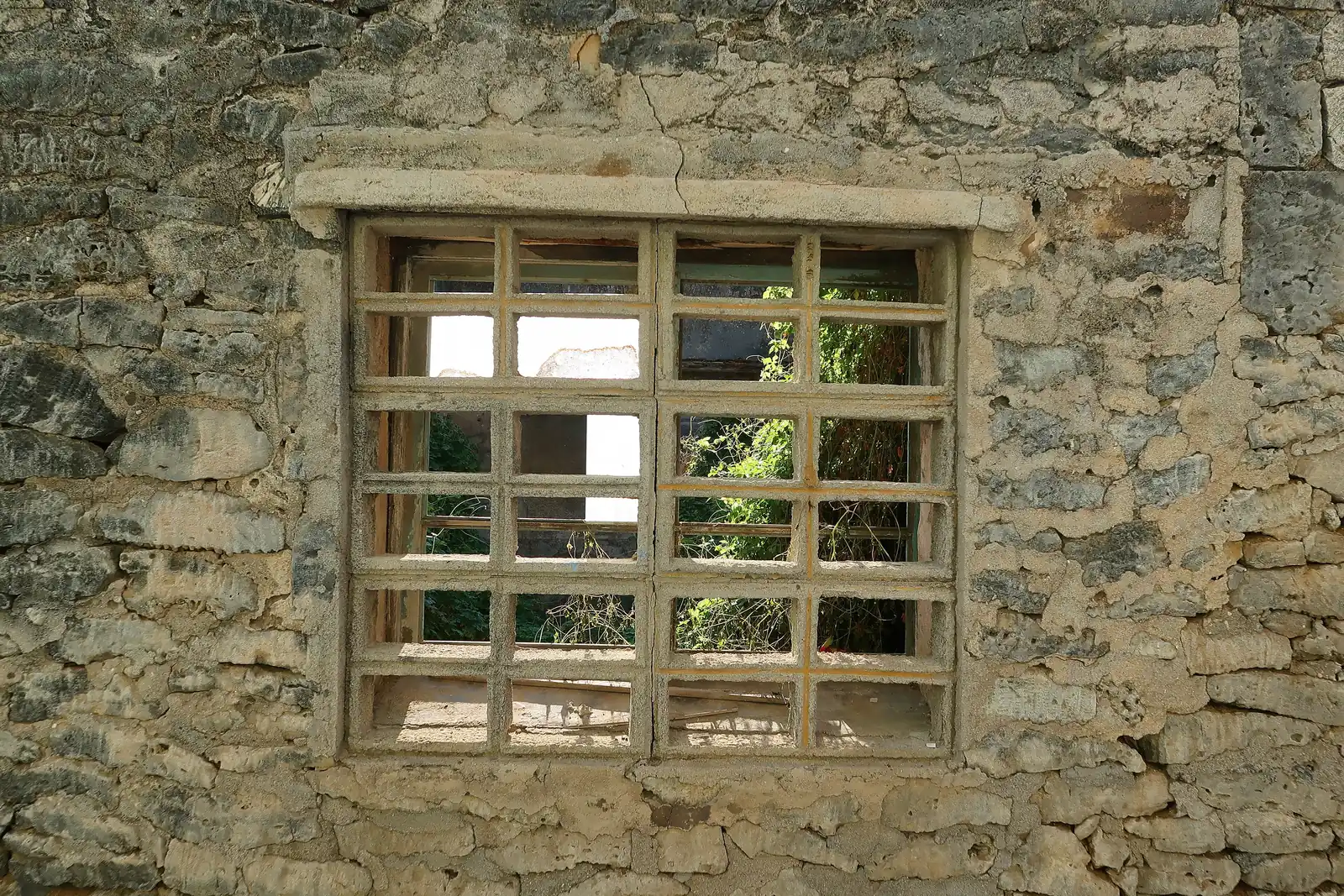
Beyond house walls, coral stone built field boundaries, compound perimeter walls and the walled crop plots, and it travelled: it was used in the city walls of Tainan and Fengshan. Use continued through the Japanese period and was supplanted after the Second World War.
Sources
- “硓𥑮石” [Coral stone], penghu.info knowledge platform, citing the Penghu Prefecture Gazetteer, Penghu County Records and the Xiyu Township Record.
- “【島民觀察】海底礁石築聚落” [Islander observations: a settlement built from reef stone], 農傳媒 Agriharvest.
- “FEATURE: Old village wins preservation battle”, Taipei Times, 28 February 2009.