
High, hard and far
Qimei is the southernmost township of Penghu, beyond Wang’an, reached by boat or by a short flight. It reaches 64 metres, second only to Damao at 70 m and higher than Magong — which on this archipelago makes it a mountain.
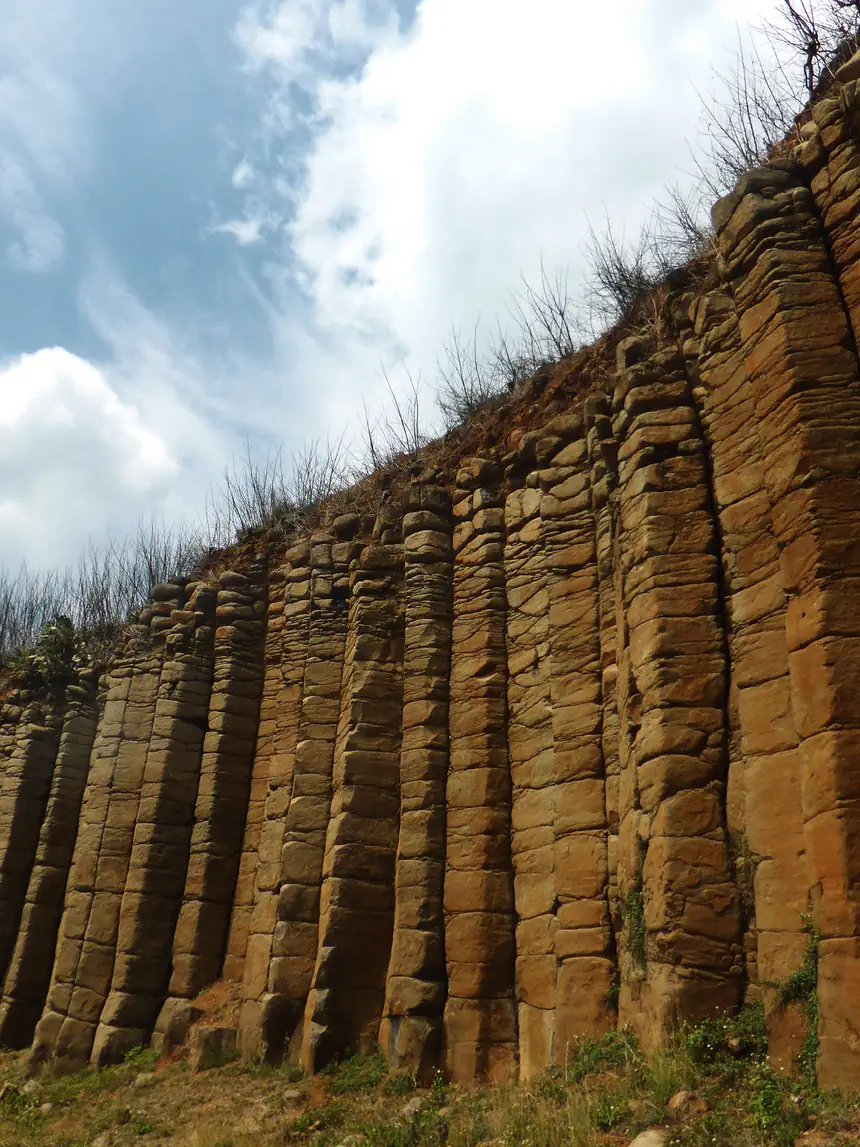
That relief comes from basalt, and the island is rimmed by it: cliffs, stacks, shore platforms and columnar exposures where the sea has cut into the lava flows. The land on top is a plateau, open, wind-scoured and thinly soiled.
The name is a century old
The island was 大嶼, Dayu, “the big island”, and under Japanese administration Ō-shima. Dayu Township was established on 11 December 1945. In 1949 both island and township were renamed Qimei, “seven beauties”, after the 七美人塚 — a stone marker commemorating seven women who, by a Ming-period tradition, took their own lives rather than be taken during a pirate raid.
The renaming is worth noting on a site about design because it is the moment the island was given a story to be visited for. Qimei’s two best-known sites — the tomb and the Twin Hearts weir — are both read today through narratives of love and loss that have nothing to do with what either structure is.
What isolation does to building
Distance from Magong meant distance from imported timber and tile, from mainland craftsmen, and from the returnee money that built Erkan. The outer islands therefore tend to hold the plainer, more direct version of the Penghu house: less render, less ornament, more visible stone, and a stronger reliance on whatever the immediate shoreline supplied.
The same isolation has preserved things. Structures survive on Qimei and Wang’an that were replaced on the main island group as soon as concrete arrived by road.
The weir
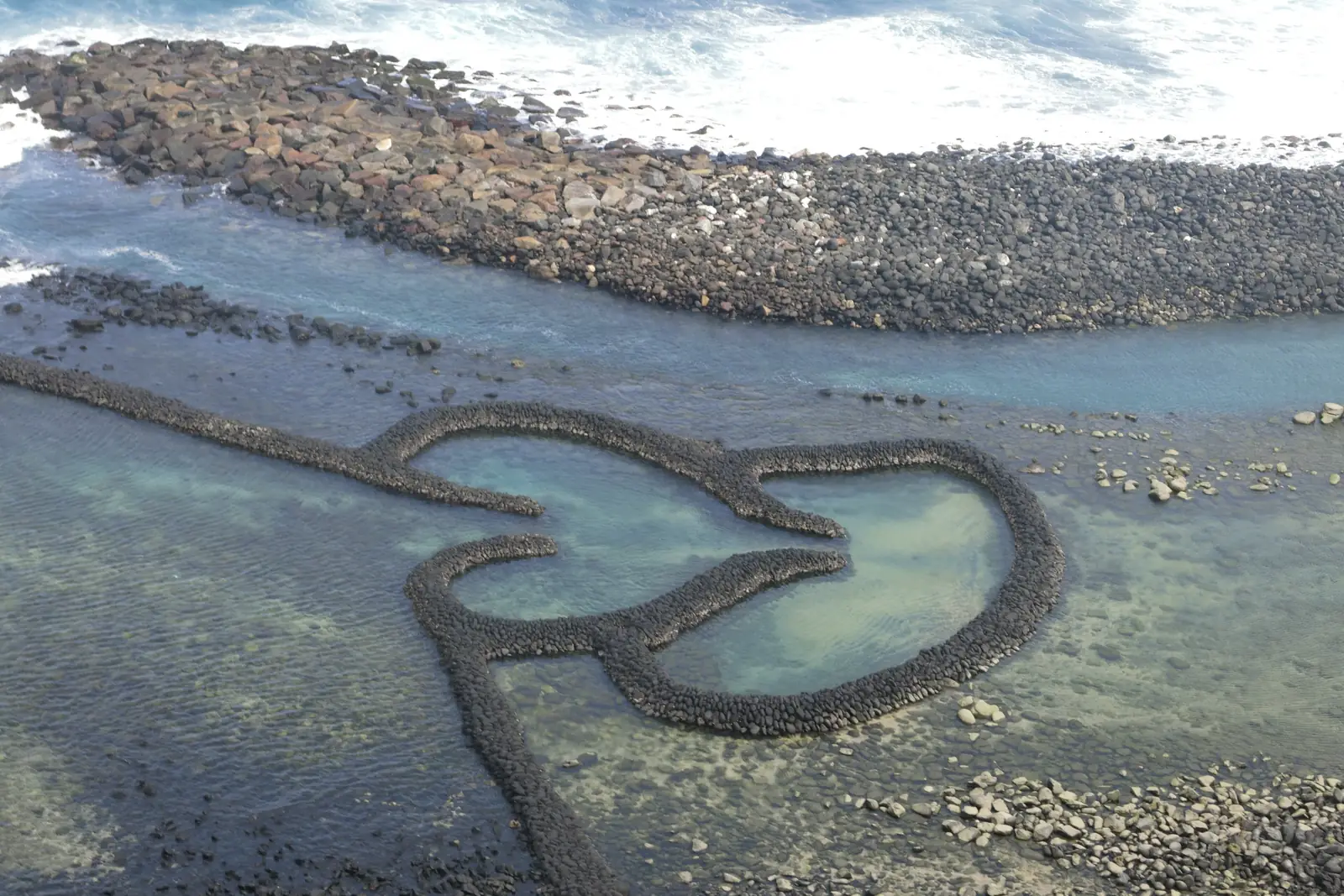
The Twin Hearts Stone Weir lies on the island’s northeast shore and is described by the Penghu National Scenic Area Administration as the best-preserved stone weir in the archipelago. It is visible only at low tide.
It is worth being clear about what it is. It is a working fishing structure of the same kind as the hundred-odd on Jibei, built to the same principles in the same two materials. Its fame rests on the accident that its two trap chambers read as a pair of hearts from the cliff above.
The last lighthouse
Qimei Lighthouse was completed in 1939 — the last lighthouse built in Taiwan under Japanese rule. It belongs to a different building culture from everything else on the island: imported, engineered, painted white, and placed for visibility rather than for shelter. Set against a coral-stone house a kilometre away, it is the clearest possible illustration of what changed in the twentieth century.
Basalt at the coast
Qimei’s coastline is a good place to see what a lava flow looks like in section: dark columnar rock over paler marine sediment, planed off at the shore platform so that the tops of the columns appear as a polygonal pavement underfoot. The mechanics are described in columnar basalt.
Sources
- Qimei, Penghu and Qimei Lighthouse, Wikipedia, for the 1945 township establishment, the 1949 renaming after the 七美人塚 and the 1939 lighthouse; with Tomb of the Seven Beauties, PENGHU-GO (Penghu County Government).
- Twin Hearts Stone Weir, Penghu National Scenic Area Administration, MOTC.
- Chen, Chao-Yuan & Lee, Ming-Ju, “Evolution of stone fish weirs in Jibei area, Penghu Archipelago (eighteenth to twenty-first century)”, Journal of Maps 19(1), 14 November 2023. Open access.
- Penghu Columnar Basalt Nature Reserve, Potential World Heritage Sites in Taiwan, Bureau of Cultural Heritage, Ministry of Culture.