
What it is
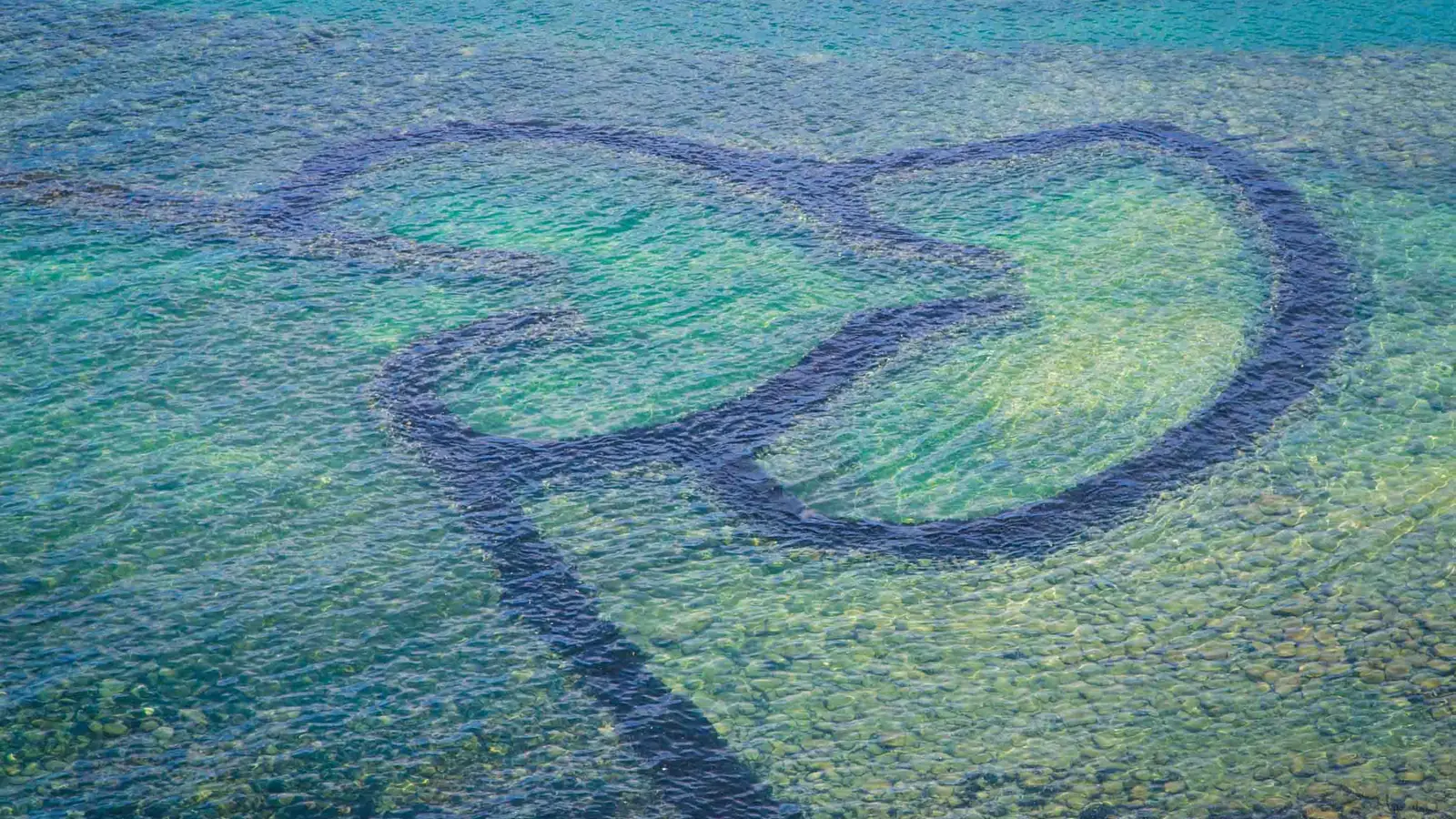
A stone weir on the intertidal flat off the northeast shore of Qimei, Penghu’s southernmost township. It is built of basalt and coral limestone, laid dry, in the same technique as the several hundred other weirs in the archipelago.
The Penghu National Scenic Area Administration describes it as the best-preserved stone weir in Penghu. That is the substantive claim about it, and it is the one worth remembering.
How the shape works
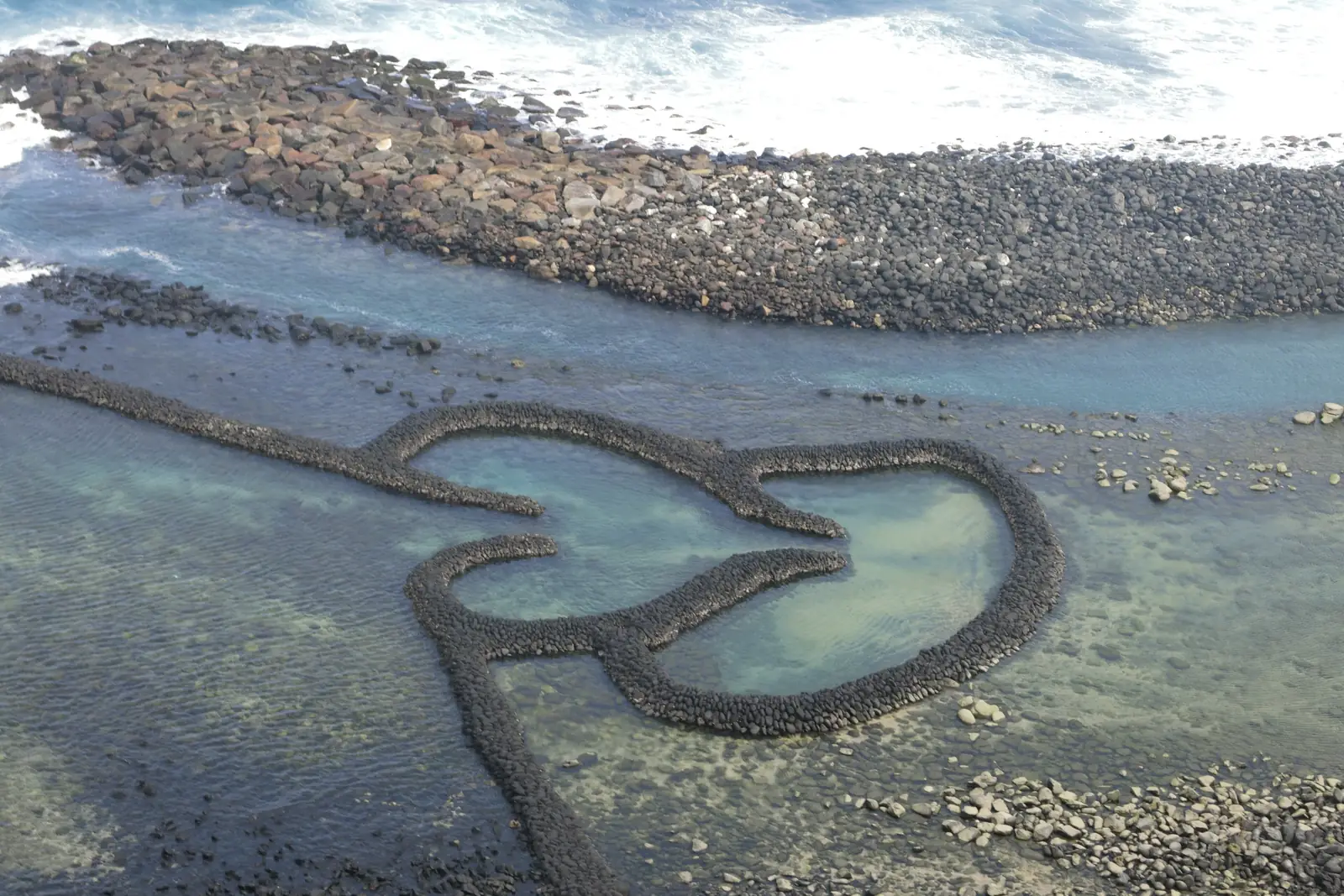
The structure is a long curving lead arm built out from the shore, terminating in two enclosed chambers, each with a narrow mouth. The arm intercepts fish travelling parallel to the shore and deflects them along its length; the chambers hold them when the water drops.
Two chambers rather than one is a straightforward capacity decision on a wide flat: the second chamber catches what escapes or overshoots the first. Their rounded, inward-curling mouths are the standard weir detail — a fish that swims in along the wall cannot easily find the opening again from inside. Seen from the cliff above, the two curled chambers read as hearts. Seen from the flat, they read as what they are.
Age: what can be said
Popular accounts date the weir to “over 700 years ago”. That figure circulates widely and has no scholarly support; no primary record establishes a construction date for this structure.
What the record does support is a frame. Weir building in Penghu is documented from the seventeenth century: the Gazetteer of Taiwan Prefecture of 1696 records two large and twenty small weirs in the archipelago, and counts rise through the eighteenth century. Most Penghu weirs are more than a hundred years old, which is why the 2001 UNESCO Convention on underwater cultural heritage applies to them. Beyond that, an honest answer is that the age of this particular weir is unknown.
Status
The Twin Hearts weir is part of the wider recognition given to Penghu’s weirs: “Penghu Stone Fish Weirs” entered Taiwan’s list of potential World Heritage sites in 2009, and the weir-building technique has designated holders at Jibei. As a structure it has long since lost its economic function — weir fisheries collapsed through the 1960s — and is maintained now as heritage.
Seeing it
It is submerged at high water. The structure only appears as the tide falls, and the full double outline only at low tide. Approaching across the flat is what shows you the construction — the battered section, the size grading, the dry laying — and none of that is visible from the cliff viewpoint above.
Sources
- Twin Hearts Stone Weir, Penghu National Scenic Area Administration, MOTC.
- Chen, Chao-Yuan & Lee, Ming-Ju, “Evolution of stone fish weirs in Jibei area, Penghu Archipelago (eighteenth to twenty-first century)”, Journal of Maps 19(1), 14 November 2023. Open access.
- Penghu Columnar Basalt Nature Reserve, Potential World Heritage Sites in Taiwan, Bureau of Cultural Heritage, Ministry of Culture.