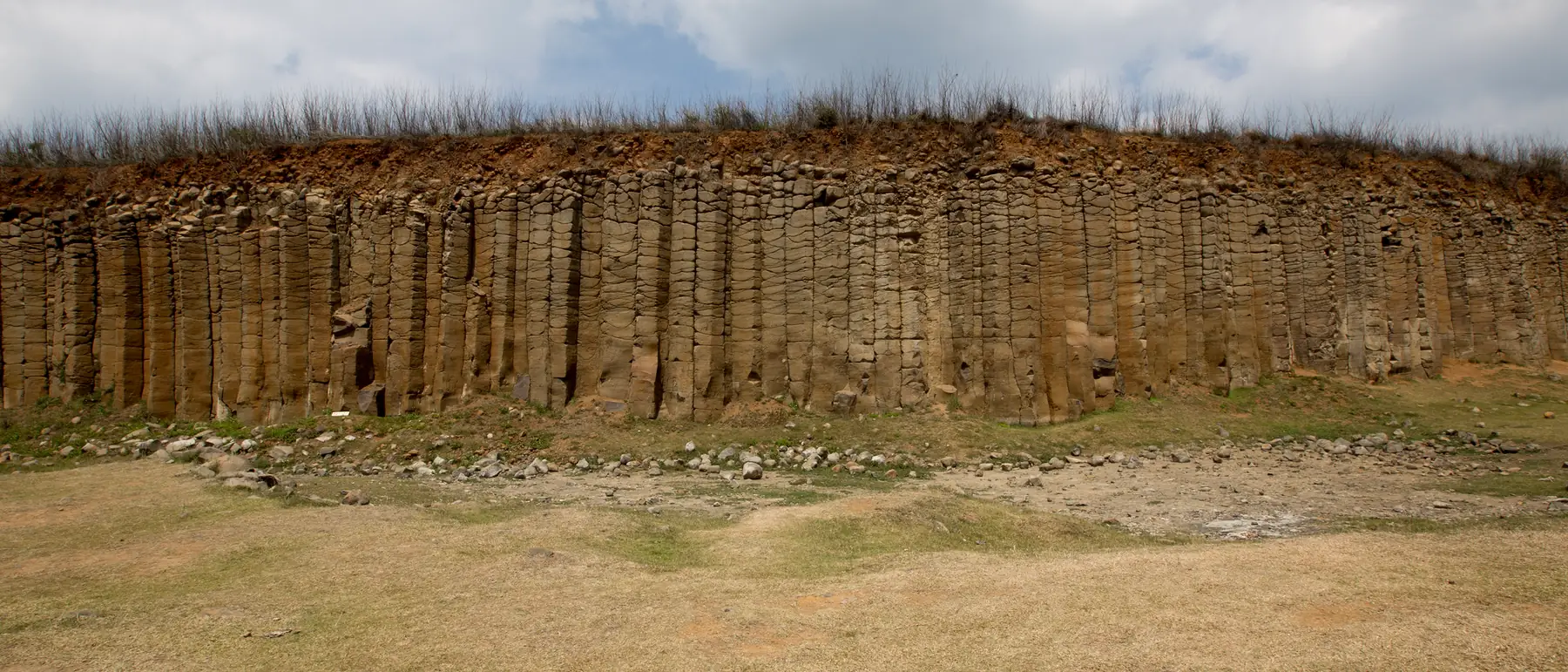

How the columns form
Basaltic lava is low in silica and runs easily, so Penghu’s eruptions were not explosive. Lava came up through crustal fractures and spread as sheets, ponding where the ground allowed. Each sheet then cooled — from the top downward and the base upward — and cooling rock contracts.
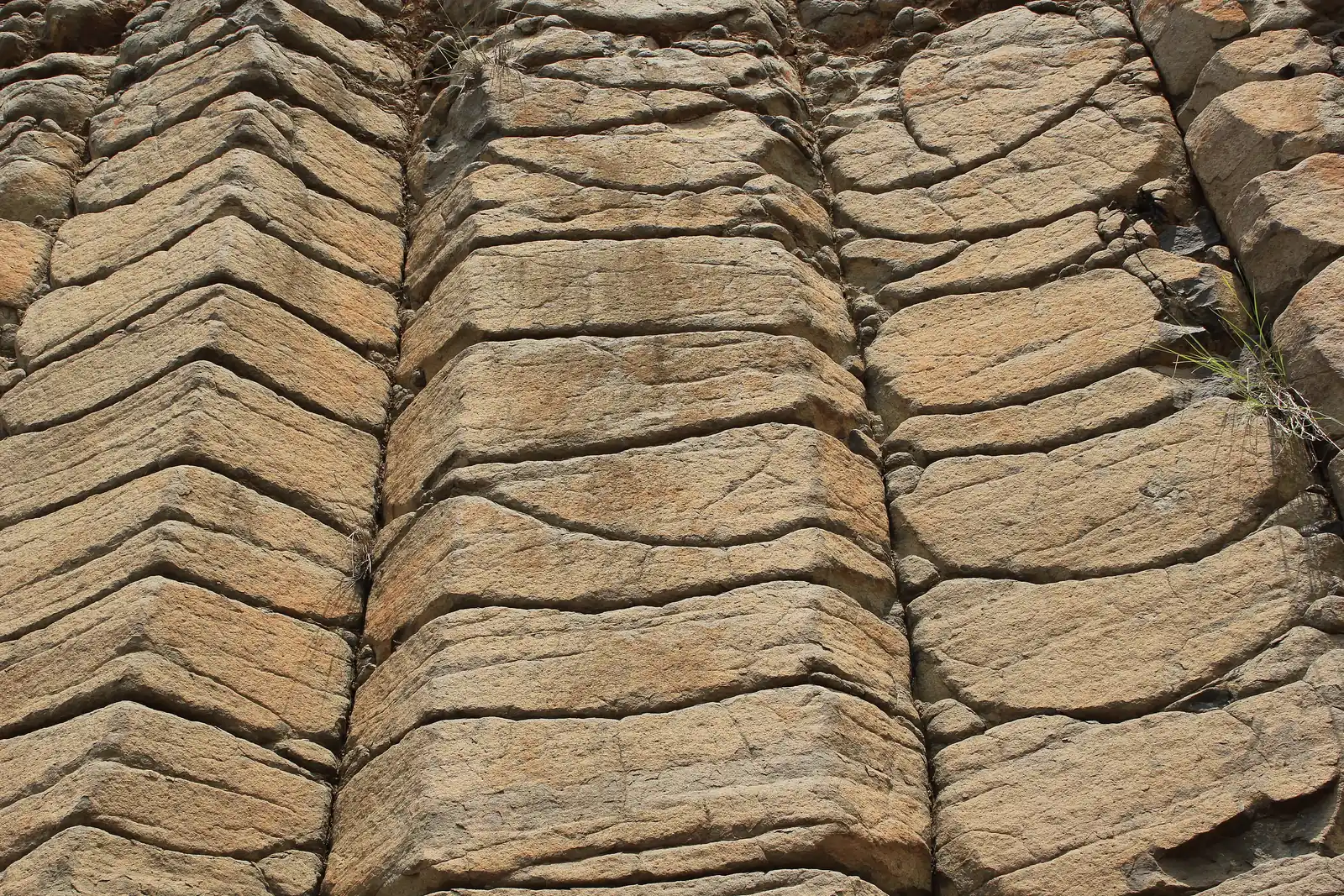
Contraction in a cooling sheet resolves into a network of cracks that meet at roughly 120 degrees, which is why the cells are commonly five- or six-sided. Those cracks then propagate perpendicular to the cooling surface, which is why the columns stand vertical in a horizontal flow. Where the flow cooled unevenly — against a slope, or around an obstruction — the columns fan, radiate or lie over like toppled dominoes.
Ages
Lava activity in the archipelago began about 18 million years ago. The oldest basalt is at Wang’an, around 17 Ma. The rock within the nature reserve dates from 13.2 to 11.8 Ma. The last eruption, at Dongyuping, was about 8 Ma. Between and beneath the basalt sheets lie sandstones and mudstones deposited in shallow marine conditions, so a Penghu cliff often reads as a sandwich: dark columnar rock over pale sediment.
Scale
The tallest exposures reach 60 to 70 metres. That is the maximum, not the norm — most accessible faces are a few metres high, and the low ones matter more historically, because a three-metre outcrop is a quarry a person can work and a seventy-metre cliff is not. The same geometry that makes the columns worth looking at made the stone worth carrying: an outcrop yields prismatic blocks with faces already formed.
The nature reserve
The Penghu Columnar Basalt Nature Reserve was declared in 1992 under the Cultural Heritage Preservation Act. It covers three uninhabited islets in the northeast of the archipelago — Xiaobaisha, Jishan and Dinggou — totalling 19.13 hectares at high tide and 30.87 hectares at low tide, with a 74.96-hectare buffer zone. It is the only nature reserve in Taiwan constituted on basalt.
It is also on Taiwan’s list of potential World Heritage sites. The case is argued under three criteria: exceptional natural beauty, with the comparison drawn to the Giant’s Causeway and Fingal’s Cave; significance for earth history; and habitat — the islets carry 52 bird species across ten orders, with protected terns breeding from April to September and green turtles nesting in the archipelago.
- First lava
- ~18 MaLast eruption at Dongyuping ~8 Ma.
- Reserve rock
- 13.2–11.8 MaXiaobaisha, Jishan and Dinggou.
- Tallest columns
- 60–70 mMaximum recorded, not typical.
Where to look
- Daguoye, Xiyu
- The most accessible major face, and the one most people photograph. It was exposed by a road cutting during the Japanese period.
- The reserve islets
- Xiaobaisha, Jishan and Dinggou are uninhabited and protected; they are seen from the water.
- South Penghu
- The southern islets carry extensive columnar coastline within the South Penghu Marine National Park.
- Any shore platform
- Where a flow has been planed off by the sea, the column tops appear as a polygonal pavement underfoot — the same geometry, seen in section from above.
Sources
- Penghu Columnar Basalt Nature Reserve, Potential World Heritage Sites in Taiwan, Bureau of Cultural Heritage, Ministry of Culture.
- “Black Pearls in the Ocean: The Basalt of Penghu”, Taiwan Panorama, July 2002.
- Penghu, Wikipedia, for administrative and climate-normal figures only.
- Daguoye Columnar Basalt, Tourism Administration, MOTC.