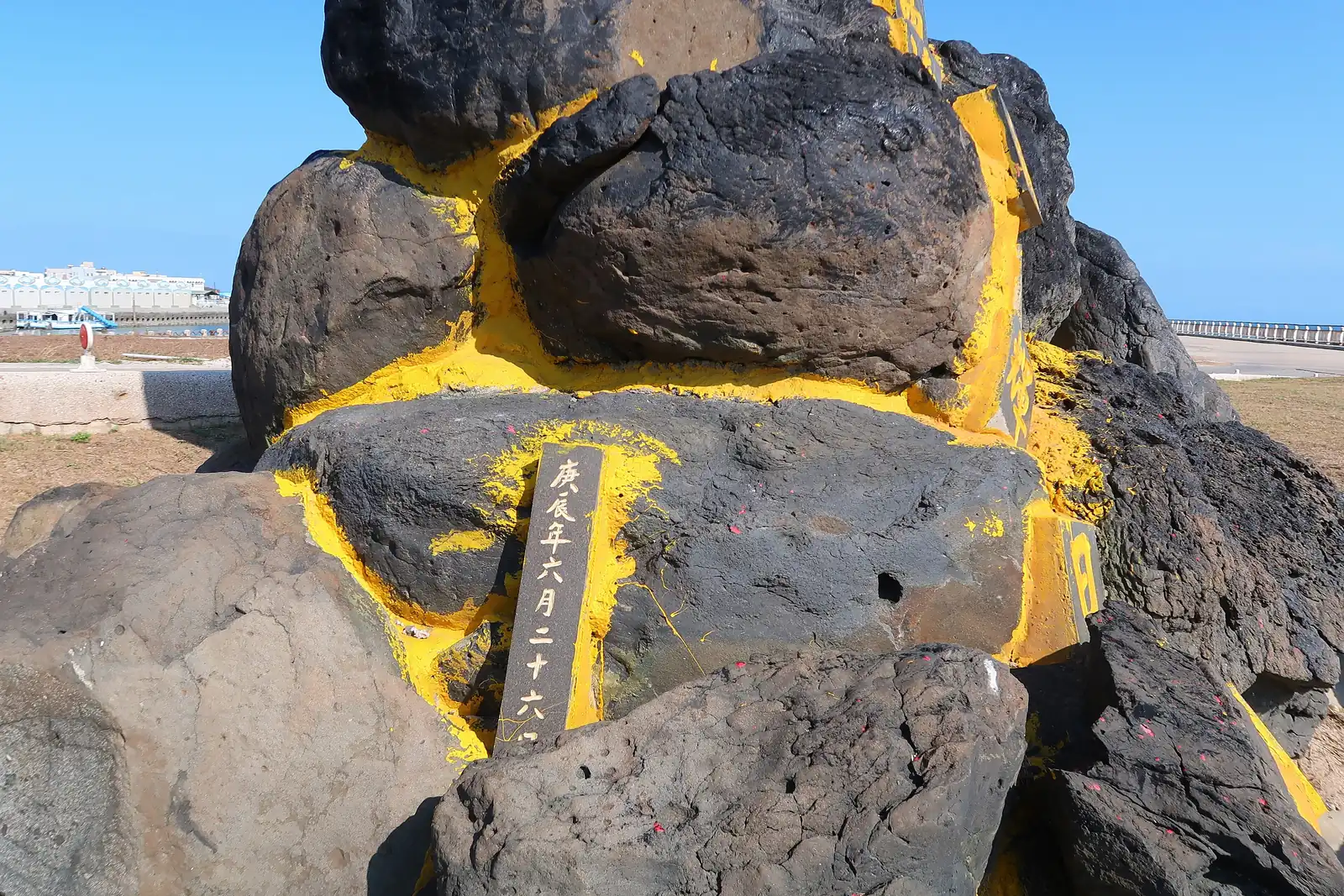

Shigandang
A 石敢當 is an inscribed stone set to turn away harm. The practice is widespread in East Asia, but Penghu’s version has an unusual emphasis: here the stones are understood to protect not only against malign influence but explicitly against wind, water and disaster. Along the coast they take tower and pillar forms rather than the simple slab common elsewhere.
They stand where lanes meet, where a street runs out toward open ground, at village entrances, and on exposed shores. A Penghu village has no wall; what it has is a set of marked points, and those points are where the settlement’s aerodynamic and social edges coincide.
Stone pagodas
石塔, stone pagodas, are the public-scale version. They are built to correct the fengshui of a settlement and to calm the wind, typically as stacked stone cones of several tiers, sometimes finished with a gourd, a dragon, a phoenix or a qilin. The largest, at Suogang, stands over ten metres high.
Unlike a shigandang, which an individual might set, a pagoda is a community undertaking on the scale of a small building — the same kind of collective investment as a weir or a temple.
The five camps
The most systematic of these markers is the 五營, the “five camps”: garrison posts of spirit soldiers stationed at the east, south, west and north edges of a settlement, with a fifth at the centre — normally the public temple.
The historic marker is a 竹符, a bamboo length about a metre long, inscribed with the name of the camp marshal or its soldiers and dressed with gold paper and red cloth, set into the ground by a ritual specialist. Over recent decades many have been replaced with stone stelae, or housed in small masonry booths on mounded, tower-like or cylindrical bases.
The result is a village perimeter defined by five discrete objects instead of a continuous line. It is a boundary you can walk to, count, and repair — and it is one of the few pieces of settlement planning in Penghu that was deliberately designed rather than accumulated.
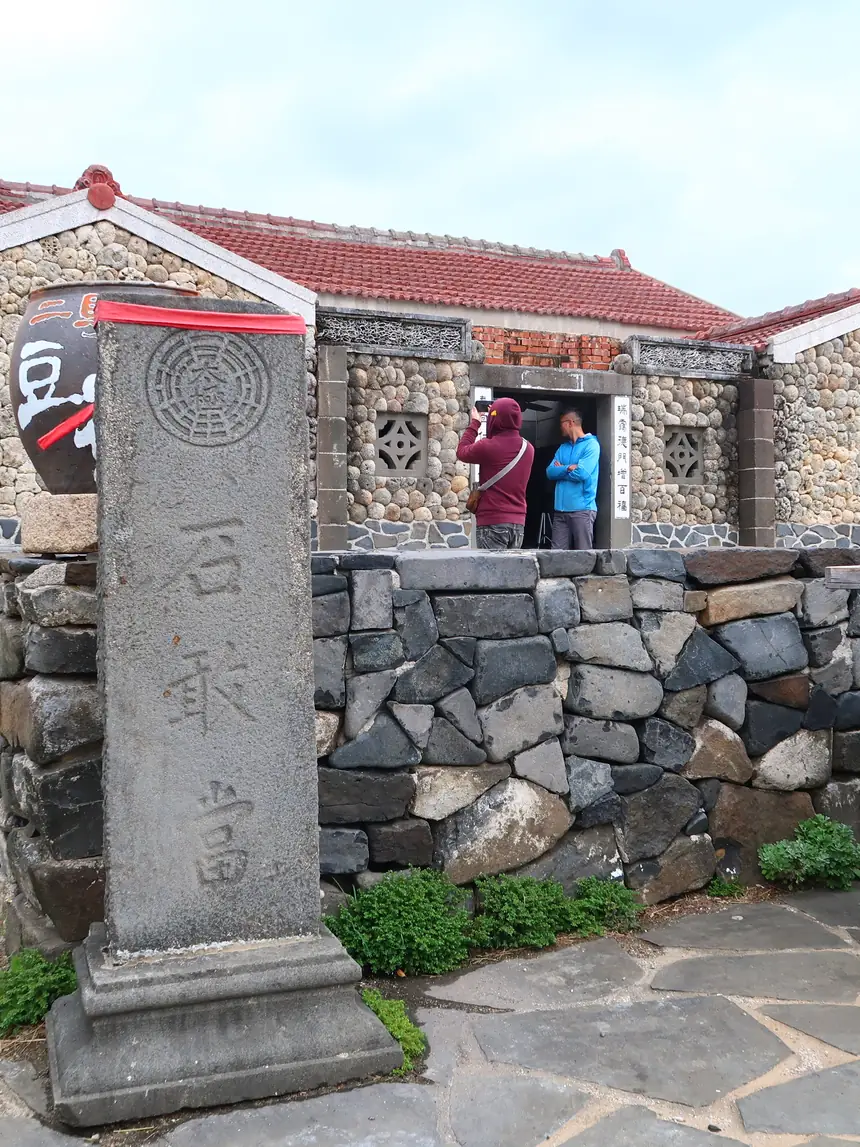
How to read them
- Position before inscription. The siting carries most of the information: junctions, gaps, edges, shore.
- Material. Basalt for the coastal stones. Their surfaces are often painted, and the paint is maintained.
- Form. A slab is domestic in scale; a pillar or tower is a village-scale intervention; a tiered pagoda is a public work.
- Company. Where a camp post has been rebuilt in masonry, look for the earlier bamboo still standing beside or inside it.
Sources
- Shigandang, Wikipedia, with Camphor Press for the Penghu forms.
- Penghu introduction, The Islands of Taiwan, Camphor Press.
- 五營數量 [The number of camp posts], penghu.info knowledge platform, and 吳永猛, 〈澎湖村落五營信仰的探討〉, Penghu Research: Proceedings of the 1st Academic Symposium, National Penghu Living Museum.