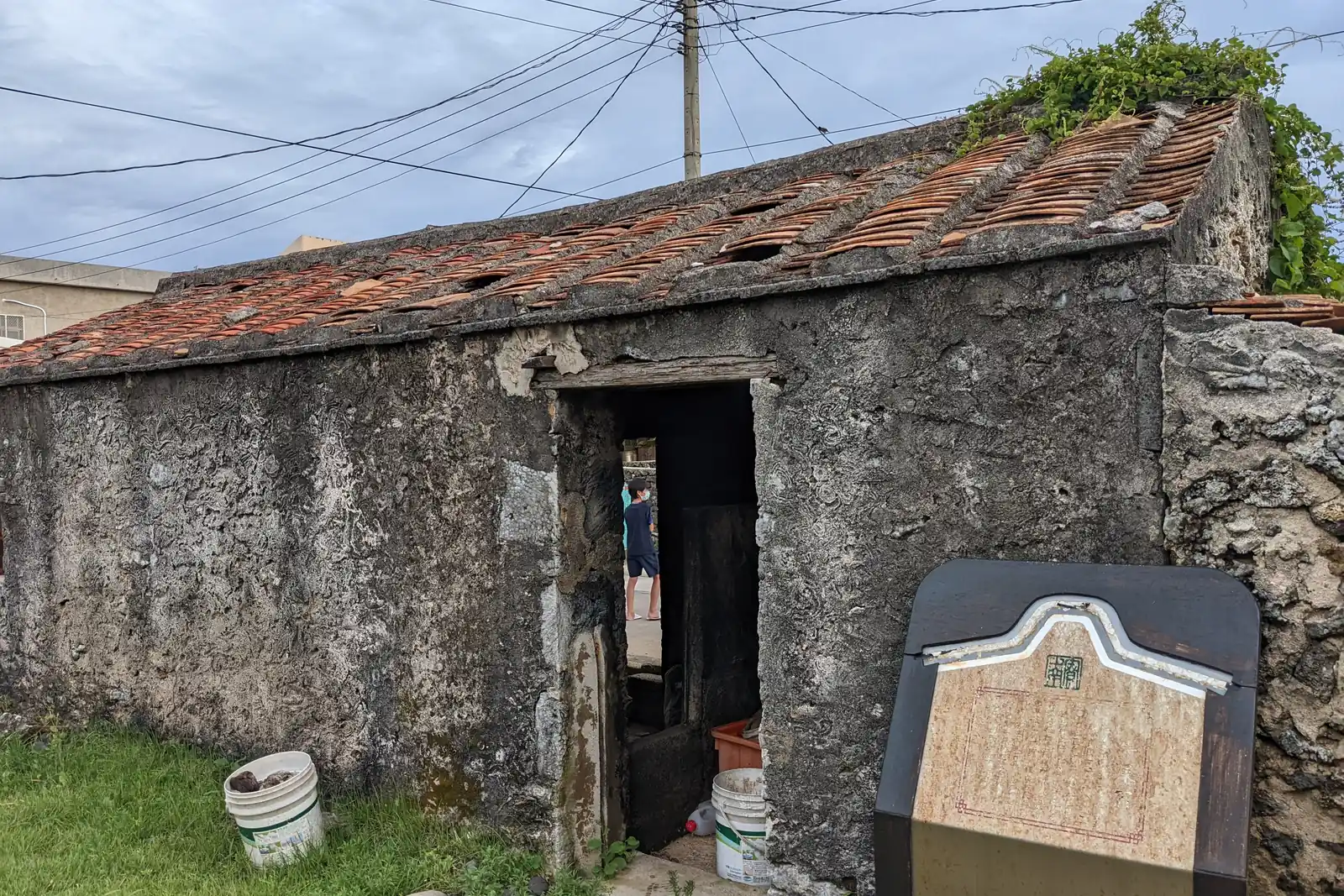

Where and why
Nanliao lies on the northeast coast of the main island, in Huxi Township — which is to say on the exposed side, facing the monsoon directly. It was among the Penghu settlements worst affected by out-migration and ageing, and it is now among the best known for community-led regeneration.
The fish stove
A 魚灶, fish stove, is a masonry block with sunken boiling pans and a chimney, used to process a catch on the spot. Penghu’s fisheries landed volumes that had to be boiled and dried before they could be kept or shipped, and the stove is the machine that did it.
The Fuji fish stove (福記魚灶) at Nanliao was built by Tai Fu-chi in 1959 and has been restored by the community. It has three parts: the stove itself, the chimney, and the brine trough.
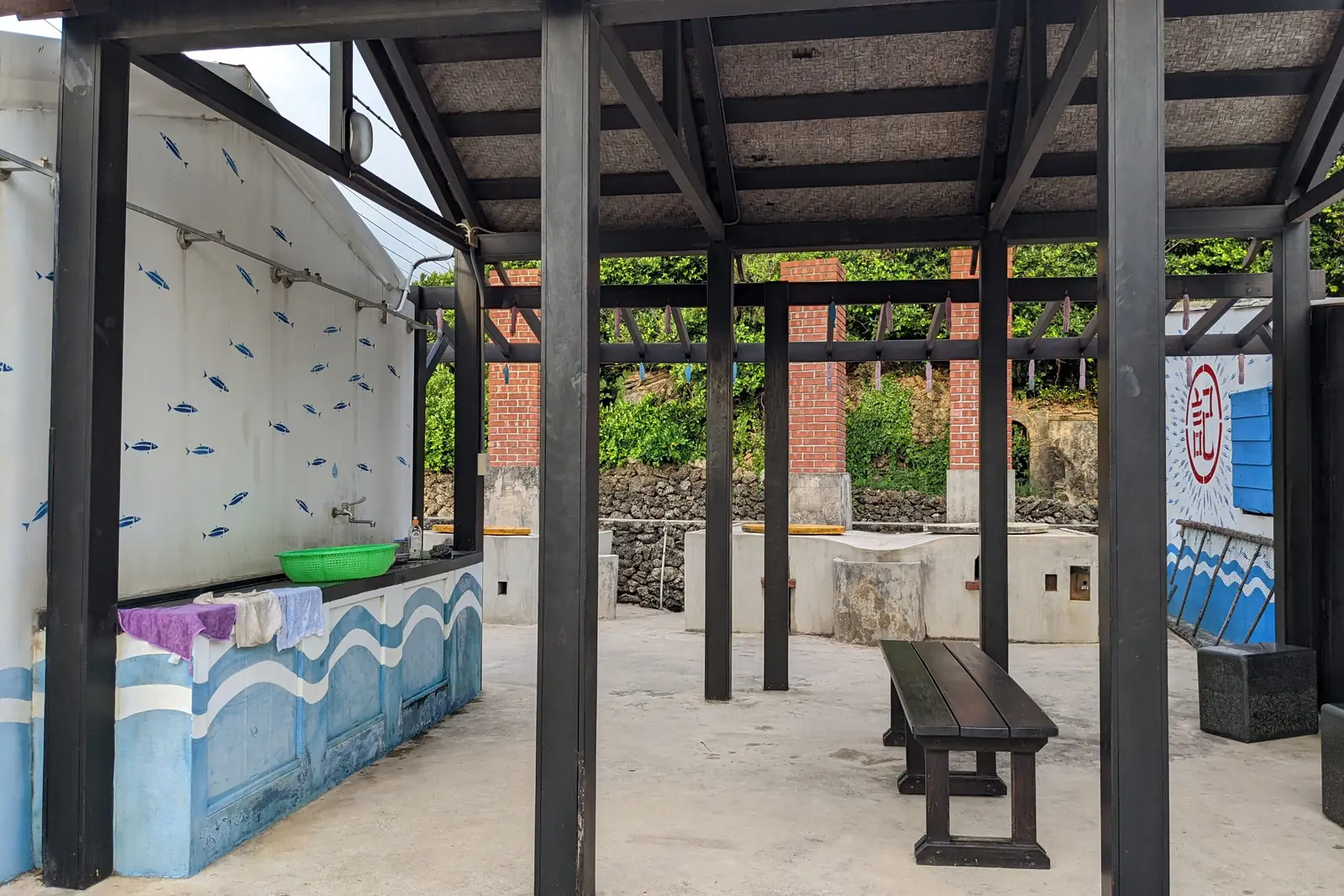
The stove belongs to the same architectural family as everything else on these islands — local stone, lime, no timber to speak of, built to survive salt — and it is a reminder that a Penghu compound was a production facility. A household’s own small stove commonly stood inside the compound wall alongside the cattle pen and the crop plot.
Cow dung as fuel
With no trees there was no firewood. Penghu households burnt dried cattle dung instead: patted onto walls to dry in the sun, or worked and dried in pits — the 牛屎窟. Nanliao’s dung pit was included in the village’s 2013 regeneration plan and rebuilt with village subsidy.
This is the least photogenic part of Penghu’s material culture and one of the most important. The absence of timber determined the structure of the buildings, the shipping economy of the islands, and the daily domestic routine, all through the same mechanism.
Wells
Nanliao’s regeneration route takes in several old wells, numbered rather than named. On an archipelago with no rivers and high evaporation, wells are the fixed points a settlement grows around, and their positions are older than any surviving building.
Recognition
- 2016
- 16th Public Construction Golden Quality Award, Executive Yuan.
- 2017 and 2018
- Selected among the Top 100 Green Destinations.
What to notice
- The stove’s three parts. Stove, chimney, brine trough. Each is a separate piece of construction with a separate job.
- The exposure. Nanliao faces the monsoon. Compare the wall heights and opening sizes here with a sheltered village.
- What is missing. There is very little decoration at Nanliao. This is what an ordinary Penghu working village looks like without returnee money.
Sources
- “Model of Rural Revitalization: Nanliao, Penghu County”, Taiwan Panorama.
- Nanliao Village, Penghu National Scenic Area Administration, MOTC.
- Penghu introduction, The Islands of Taiwan, Camphor Press.